

How to Use a Meat Thermometer
Dead Meat Society doesn’t care about ego and we’re dead serious about not guessing on that poultry temp. You don’t need a lab coat. You need a probe, the thickest-part of the meat, and the patience and trust to believe the number. Oh, and maybe you need a new mat thermometer if you can't trust it!

How to Use a Meat Thermometer
Color lies. Juices lie. Your uncle’s thumb method lies with confidence. A high quality meat thermometer tells the truth. Learning how to use a meat thermometer for grilling and BBQ is the fastest way to stop serving “I think that's Medium-Rare.”
Dead Meat Society doesn’t care about ego and we’re dead serious about not guessing on that poultry temp.
You don’t need a lab coat. You need a probe, the thickest-part of the meat, and the patience and trust to believe the number. Oh, and maybe you need a new mat thermometer if you can't trust it!
Pick a thermometer that fits how you cook
Instant-read: poke, wait a couple seconds, pull. Best for steaks, chops, burgers, checking in the moment.
Leave-In probe (Wired): Temperature probes stay in the meat, display outside the grill. Great for thicker cooks and long smoking sessions, were talking, briskets and pork butts, even thick steaks.
Leave-In probe (Wireless): Same job as the wired probe, no cord tying you to the grill. Bluetooth versions talk straight to your phone, but wander too far and you'll lose the signal right when you need it most. WiFi versions connect to your home network instead, so you can check the meat from the couch, the store, wherever. Know which one you bought before you trust it.
Cheap mystery dial stuck in the lid: if it's calibrated and high quality (which is a big if), that's giving the temperature of the grill, not the meat. It is useful, but not the same job. Most Leave in Probes will actually have a probe for the meat and a probe to use on the grill grate for your grill temp.
If your instant-read takes 20 seconds and drifts like a politician, replace it! A bad thermometer is worse than no thermometer because it gives you fake confidence.
Step 1: Know what number you are hunting
Targets people commonly cook to (USDA ballparks — always verify with your own thermometer and current guidance you trust):
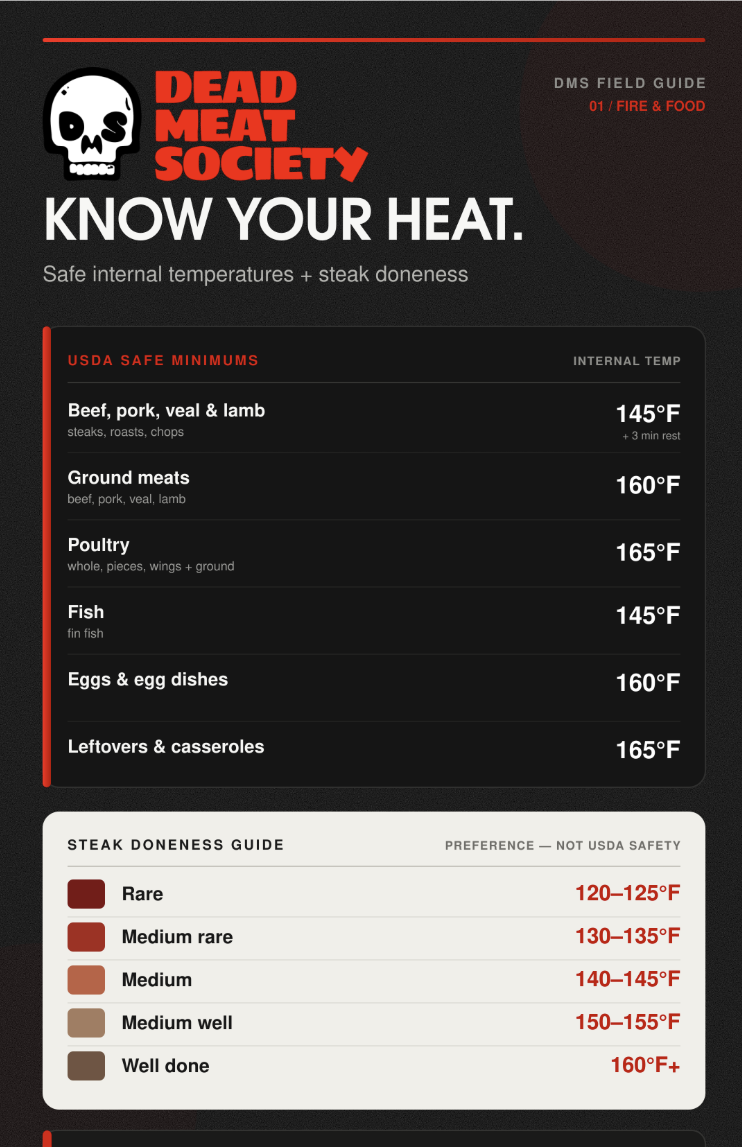
Dead Meat Society will not invent fake precision science for you. Buy a thermometer. Use it. Trust it over grill marks.
Step 2: Place the probe like you mean it
Aim for the thickest part of the meat.
Avoid bone — bone reads hotter than the muscle.
Avoid fat pockets — you want the center of the muscle.
For people that use them for burgers, the center of the patty from the side can be cleaner than stabbing from the top through a cheese blanket. We promise the smash burgers are up to temp!
For chicken and turkey shoot for the thickest part of the breast and the thigh near the joint without hitting bone.
It's important to know where the sensor is on your thermometer, most high quality temp probes the sensor lies in the tip of the probe. Its ok to move the probe around, work to find the coolest part of the meat, don't trust the first jab!
Tip box: Check more than one piece in a crowded cook. The front-left chicken thigh is not a legal representative for the back-right.
Step 3: Time the check so you don’t bleed the cook dry
There's an old BBQ adage: “If you're lookin’, you're not cookin'!" The same theory applies here. Don't puncture the meat every thirty seconds like you are trying to deflate it. After you get your first temp reading give it some time and come back, as you get closer to the end you can check more regularly.
Step 4: Rest without undoing your work
Pull poultry and ground meat at proper temp. For steaks, many cooks pull near their preferred doneness and rest a few minutes so juices settle and temp finishes climbing a bit.
Tent loosely with foil if the wind is blowing but don't wrap tight, steam is the enemy of texture and crust! Believe it or not leaving your meat un wrapped and on a plate in a warm area the meat will continue to cook and carry over to where you want it.
Resting meat takes longer than expected, don't worry about a 10-15 minute rest, the steak wont cool off, it will be even better!, you will notice that piece of meat will actually keep cooking even off the grill, the temps will increase and then eventually after 10-15 mins start coming back down. Rest is not optional fluff. It is part of the cook.
Grill habits that make thermometers happier
Two-zone fire so you can finish gently instead of incinerating the exterior while the center lags.
Tools that move meat cleanly — tongs and spatula — so you are not dropping a half cooked steak into the coals. Dead Meat Society gear like Dead Grip Tongs and the Dead Skull Spatula live for that control!
Be careful when adding a sauce with a high sugar content onto a piece of protein that's almost done, that sauce may burn and you may think the cook is over when it's not.
Common thermometer fails
Reading the grill lid thermometer and calling the steak done
Touching bone and celebrating early
Checking only the thinnest piece
Never calibrating a suspect thermometer in ice water / boiling water.
Guessing “one more minute” five times after the number already arrived
Calibrate when something feels wrong
Ice water should read about 32°F. Boiling water should read about 212°F at sea level (adjust mentally if you live in the clouds). If your thermometer is off by a mile, recalibrate if it allows it, or replace it. Dead Meat Society would rather you spend money on a working probe than on another sauce bottle you will not use.
Battery death mid-cook is a classic villain. Fresh batteries before a holiday cook. Backup instant-read in the drawer if you feed crowds.
Teaching the thumb test the honest way
People love the palm-touch doneness myth. Fun party trick. Bad primary system. If you want to learn feel, use the thermometer and the finger poke together for a while so your brain maps numbers to texture. Then, when you forget the probe at a friend’s house, you are less lost. Feel is a backup singer. The probe is the lead vocal.
The last ditch effort (but please do everything to avoid it!) is the “cut to peek”. You can do it, but you will lose juices, and you still might misread color under bad patio lighting. Probe first and trust the probe.
Truth over bravado
How to use a meat thermometer: thickest part, right target, believe the readout, rest. That is beginner excellence without the food-safety fanfic.
Dead Meat Society cooks for Flame. Family. Community. Feed Everyone — and feeding everyone includes not playing bacterial roulette for vibes.
More grilling and bbq education on The Pit. Follow along @deadmeatsociety on all socials
TL/DR
Buy a real thermometer. Ditch the thumb test and the lid dial, they're both liars.
Thickest part of the meat, away from bone and fat. That's where the truth lives.
Know your number before you start poking. 165°F poultry, 160°F ground meat, 145°F pork with a rest, 135°F Medium Rare Steak.
Check it, walk away, check it again. Constant poking bleeds the cook dry.
Rest is part of the cook, not a suggestion. The temp keeps climbing after it comes off the grill.
Calibrate in ice water and boiling water if something feels off. A busted thermometer is worse than none at all.
Probe it. Trust it. Serve it hot. Brag later.
